

Decision Fatigue: Why Too Many Choices Make You Exhausted
Have you ever reached the end of a long day and felt strangely incapable of making one more decision?

You may have spent hours answering emails, choosing between competing priorities, responding to messages, solving problems, deciding what to buy, what to eat, what to postpone, what to say, and what to do next.
Then someone asks a simple question:
“What do you want for dinner?”
And suddenly, even choosing between two restaurants feels exhausting.
You may think you are simply tired. But sometimes, something more specific is happening: decision fatigue.
The concept describes the mental burden that can develop when we repeatedly have to make decisions, particularly when those decisions require effort, comparison, uncertainty, or self-control.
Recent research has renewed interest in decision fatigue, cognitive load, choice overload, and decision-making, while also showing that the phenomenon is more complicated than the popular idea that we simply “run out” of mental energy after making a certain number of choices.
So, what is decision fatigue, and why can everyday decisions sometimes feel much harder than they should?
What Is Decision Fatigue?
Decision fatigue refers to a state in which repeated or demanding decision-making may make subsequent decisions feel more difficult, effortful, or aversive.
Every decision requires some form of mental processing. Should I answer this email now?
Which task should I do first? Should I accept this opportunity? Which product should I buy?
Should I keep working or take a break? Should I say yes or no?
Some choices are almost automatic. Others require us to compare alternatives, predict consequences, manage emotions, consider other people’s expectations, and tolerate uncertainty.
The more complicated the decision environment becomes, the greater the potential cognitive load.
A 2026 integrative review published in Frontiers in Cognition examined research on decision fatigue across different domains. The researchers identified multiple contributing factors, including decision complexity, workload, frequency of decisions, uncertainty, time of day, breaks, and the number of alternatives involved.
The review also identified several possible consequences, including reduced decision efficiency, slower decision-making, choosing easier or safer options, and greater cognitive effort.
In other words, decision fatigue is not simply about making “too many decisions.”
It can also involve the type of decisions you are making, how difficult they are, how frequently they occur, and the conditions surrounding them.
Why Do Too Many Choices Feel Exhausting?
Imagine that you need to buy a pair of shoes.
You walk into a store and find three options.
You compare them quickly and choose one.
Now imagine entering another store with 200 pairs.
Suddenly, the task changes.
You are no longer simply choosing a pair of shoes. You are comparing colors, materials, brands, prices, reviews, styles, comfort, durability, discounts, and hundreds of possible combinations.
More options do not necessarily create more freedom in practice.
Sometimes, they create choice overload.
Choice overload occurs when the number or complexity of available options makes choosing more difficult.
And modern life is exceptionally good at producing choices.
Streaming platforms give you thousands of movies.
Online stores give you endless products.
Social media gives you an enormous number of possible sources of information.
Food delivery apps give you dozens of restaurants.
Your phone gives you notifications, messages, emails, videos, advertisements, and decisions every few seconds.
Even when each individual choice seems insignificant, the constant requirement to evaluate options can contribute to mental overload.
This is one reason decision fatigue and choice overload are related, but not identical.
Choice overload is largely about the environment.
Decision fatigue is more concerned with what happens to the decision-maker when decision-making becomes repeatedly demanding.
The two can occur together.
And when they do, even a simple decision can suddenly feel surprisingly difficult.
Decision Fatigue Symptoms: How Does It Feel?
Decision fatigue symptoms are not the same as symptoms of a medical disorder. Decision fatigue is a psychological concept, not a diagnosis.
Still, people often recognize certain patterns when they have been making demanding decisions for an extended period.
You may notice that you:
- avoid making decisions altogether;
- keep postponing simple choices;
- feel overwhelmed by too many options;
- become impatient with decisions that normally feel easy;
- choose the easiest option simply to stop thinking about it;
- rely more heavily on defaults or recommendations;
- experience analysis paralysis;
- second-guess choices after making them;
- feel mentally exhausted by comparing alternatives;
- become less willing to deal with another complicated decision.
Sometimes, the problem is not that you do not know what to do. The problem is that deciding itself has become exhausting. That distinction matters.
You might spend twenty minutes deciding which email to answer first and then wonder why you cannot concentrate on the actual work. The decision did not necessarily require twenty minutes.
Your mind simply became caught in a loop of comparison, uncertainty, and evaluation.
Decision Fatigue and Overthinking
This is where decision fatigue and overthinking can reinforce each other. Imagine that you need to choose between two job opportunities. You compare the salary. Then the location. Then the benefits. Then the career possibilities. Then what your family might think. Then what could happen if you choose incorrectly. Then you search for more information. Then you find another opinion. Then another.
Eventually, you are no longer simply making a decision. You are trying to eliminate uncertainty.
And that is an impossible task. No matter how much information you collect, important decisions rarely come with complete certainty. This is why overthinking and decision-making can become a difficult combination. The search for the perfect decision can prevent you from making a reasonable one. Sometimes, the goal should not be finding the decision that is guaranteed to be correct. It should be finding a decision that is good enough for the information available right now.
Is Decision Fatigue Actually Real?
This is where the science becomes particularly interesting.
The popular version of decision fatigue sometimes suggests that people possess a limited daily supply of mental decision-making energy, and that every choice drains a little of that supply.
The reality is more nuanced. A 2026 systematic review published in Frontiers in Cognition synthesized research across multiple domains and identified patterns consistent with decision fatigue. However, other research has challenged the idea that repeated decisions inevitably produce a broad decline in decision quality.
For example, a large field study published in Communications Psychology in 2025 found no evidence for a general decision-fatigue effect in the healthcare data examined. The authors argued that their findings cast doubt on the idea of decision fatigue as a universal, domain-general phenomenon, while acknowledging that weaker or context-specific effects could still exist.
This distinction is important. Science does not require us to choose between “decision fatigue is completely fake” and “your brain has a fixed number of decisions per day.”
The more useful interpretation is that decision-making can become more difficult under certain combinations of cognitive demands, workload, uncertainty, repeated choices, and contextual conditions, but the exact mechanisms and size of these effects are still being investigated.
That is a much more interesting story than the simple internet version.
Why You May Make Different Decisions When You Are Mentally Tired
When decision-making becomes effortful, people may become more attracted to simpler options. Instead of comparing five alternatives, you choose the first acceptable one. Instead of researching every possibility, you follow a recommendation. Instead of making a complicated decision, you postpone it.
Instead of asking what you actually want, you choose the default. This does not necessarily mean that your judgment has disappeared. It may mean that the cost of continuing to evaluate alternatives has become too high.
The 2026 integrative review identified tendencies such as choosing easier or safer options, reduced decision efficiency, lower decision-making rates, and greater cognitive effort among the effects reported across the literature.
This connects decision fatigue with another important concept: cognitive load.
Your brain does not operate in an empty room.
It is processing information, remembering priorities, responding to interruptions, managing emotions, and anticipating consequences.
Add a continuous stream of decisions to that environment, and the mental workload can become substantial.
Decision Fatigue, Stress, and Emotional Load
Not all decisions are emotionally neutral. Some choices require us to manage fear. Others involve conflict. Some affect money, relationships, career opportunities, or our sense of identity.
These decisions can be much more demanding than choosing what to have for lunch.This is one reason stress and decision-making deserve attention. When a decision carries emotional consequences, you may spend much more mental effort trying to predict what will happen.
You may also become more sensitive to uncertainty. That can lead to hesitation, avoidance, or repeated reconsideration. The decision itself may not be objectively impossible.
But the emotional cost of deciding can make it feel much heavier. This is particularly relevant in everyday life because many people are not simply managing a large number of choices.
They are managing choices while simultaneously dealing with deadlines, relationships, financial concerns, work pressure, digital distractions, and expectations from other people.
The result can be a form of mental exhaustion that makes even ordinary decisions feel unnecessarily complicated.
How to Overcome Decision Fatigue
If you recognize yourself in this description, the answer is not to eliminate every decision from your life. That would be impossible.
The more practical approach is to become intentional about which decisions deserve your attention.
1. Simplify Repeated Decisions
If you make the same decision every day, consider creating a routine.

What will you eat for breakfast? When will you exercise? When will you check email? What will you wear for work? Which tasks should happen first? A routine can reduce the number of times you have to consciously decide what happens next.
This is one reason habits and routines can be useful for cognitive efficiency.
You are not necessarily becoming less flexible.
You are simply removing unnecessary decisions from your mental workload.
2. Reduce Choice Overload
If five options are enough, you may not need fifty. This applies to shopping, entertainment, work processes, and even personal goals. Too many alternatives can create analysis paralysis, particularly when the differences between options are small. Try narrowing the field before evaluating it.

Instead of asking:
“Which of these 37 options is the absolute best?”
ask: “Which three options are good enough to consider seriously?”
That small change can make decision-making much easier.
3. Separate Important Decisions From Trivial Ones
Not every decision deserves the same amount of mental energy. Choosing a new career deserves more reflection than choosing between two nearly identical notebooks. When every decision receives maximum analysis, your attention becomes scattered.
Create categories.
Important decisions: slow down.
Routine decisions: simplify.
Low-stakes decisions: decide and move on.
This is not laziness. It is decision prioritization.
4. Create Defaults
Defaults are pre-decided options that reduce the need to repeatedly choose. You can create a default weekday breakfast.
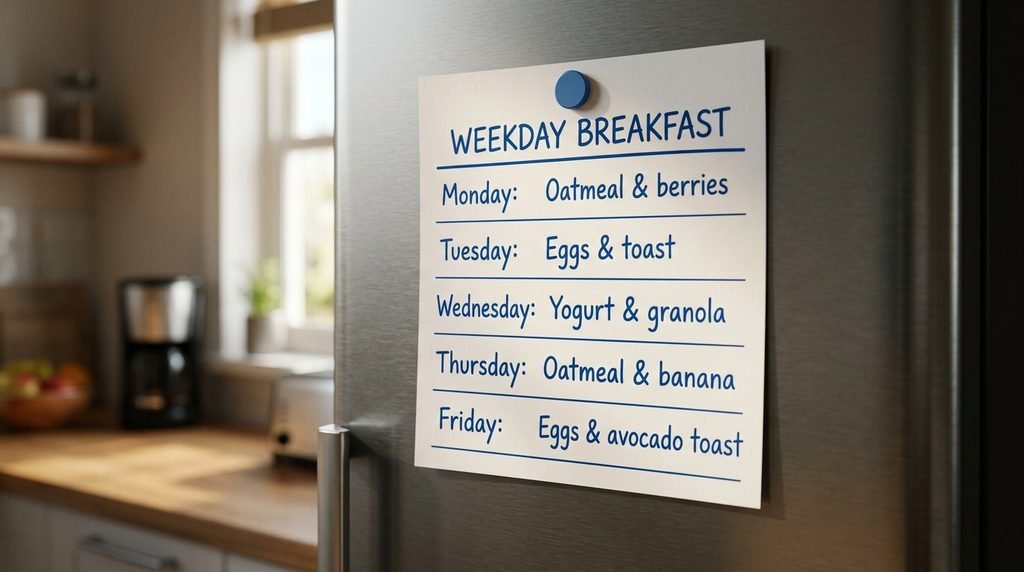
A default workout schedule. A default time for checking messages. A default process for handling routine emails. A default list of groceries.
The goal is not to make your life rigid. The goal is to preserve mental space for decisions that actually require thought.
Research published in 2026 examined how cognitive load and default nudges interact in decision-making (“Erfanian et al., 2026), finding that pre-selected options can improve response efficiency under cognitive load, although their effects on accuracy depend on whether the default aligns with the most probable response.
5. Stop Trying to Make Every Decision Perfect
Perfectionism can make decision-making unnecessarily expensive.
You may keep searching for more information because you are afraid of choosing incorrectly.
But more information does not always produce more certainty.
Sometimes it simply produces another comparison.
If the consequences are manageable, consider setting a reasonable decision deadline.
Gather the information you genuinely need.
Then decide.
A decision does not have to be perfect to be useful.
6. Give Your Attention Fewer Targets
Your mental energy is influenced not only by the number of decisions you make, but also by how fragmented your attention becomes.
Notifications, messages, open browser tabs, social media, emails, and constant interruptions can create a background layer of cognitive overload.
Reducing unnecessary interruptions can make decision-making feel less chaotic.
Sometimes, improving decision quality starts with improving attention management.
A Simple Decision-Making Rule
The next time you find yourself staring at a decision and feeling strangely exhausted, pause.
Ask yourself three questions:
Does this decision actually matter?
How many options do I genuinely need to consider?
Can I create a simpler default for next time?
These questions can help you distinguish between a decision that deserves careful thinking and one that is consuming mental energy simply because the choice environment is unnecessarily complicated.
And there is another useful question:
Am I looking for the best decision, or am I trying to eliminate all uncertainty?
Those are very different goals.
The Real Problem May Not Be Too Many Decisions
Sometimes, what feels like decision fatigue is actually a combination of several things.
You may be tired.
You may be stressed.
You may have too much information.
You may be distracted.
You may be facing an emotionally difficult choice.
You may have too many competing priorities.
Or you may simply be trying to make every decision perfectly.
That is why understanding human behavior and decision-making requires more than one simple explanation.
The brain is constantly balancing effort, attention, emotion, uncertainty, and goals.
And when those demands accumulate, choosing can become harder.
The solution is not necessarily to become better at making hundreds of decisions.
Sometimes, it is to design your life so that fewer unnecessary decisions need to be made in the first place.
One Last Thought
You do not have to optimize every choice. You do not have to compare every possibility. And you certainly do not have to make every decision perfectly. Some decisions deserve deep reflection.
Others deserve a simple answer. Learning to tell the difference may be one of the most useful decision-making skills you can develop. Because a clearer mind is not necessarily a mind that thinks about everything.
Sometimes, it is a mind that knows what is worth thinking about.
Research source:
Choudhury, N. A., & Saravanan, P. (2026). An integrative review on unveiling the causes and effects of decision fatigue to develop a multi-domain conceptual framework. Frontiers in Cognition, 4.
Erfanian, M., Meunier, L., & Gajewski, J.-F. (2026). The Effect of Cognitive Load and Default Nudges on Decision-Making: Experimental Evidence From a Behavioral Study. Journal of Behavioral Decision Making, 39(2), e70081. https://doi.org/10.1002/bdm.70081
Read More
Decision fatigue is only one piece of the puzzle. When mental effort builds up, it can also affect how we respond to tasks we already know we should do.
If you want to understand why we sometimes delay action even when we know exactly what needs to be done, continue with: